Homepage

GWZO – Understanding Central and Eastern Europe

The Leibniz Institute for the History and Culture of Eastern Europe (GWZO) is one of the world’s leading research and educational institutions for the study of the history and culture of Central and Eastern Europe. Our wide-ranging, interdisciplinary approach and broad historical scope are distinctive: From antiquity to the present day, we explore the unique features and transformations of this historically and geopolitically significant region. The GWZO’s research focuses on some of the most urgent issues of our time: dynamics of globalisation and migration, knowledge systems and competing historical narratives, environmental challenges and violence. 

Researchers at the GWZO conduct foundational research within four permanent departments and a number of rotating junior research groups. While our core expertise lies in Central and Eastern Europe, our work also extends to adjacent regions – from the Balkans and the Caucasus to Northern Europe. The GWZO’s research is marked by a commitment to global perspectives and critical reflection on regional concepts. Across Central and Eastern Europe and beyond, we maintain a dense network of long-standing academic partnerships. 

For more than 30 years, we have been presenting our research findings at national and international levels. In addition to academic publications and exhibitions, we develop digital formats to share our research with both specialist audiences and the general public. In so doing, we make history – and the way it is narrated – accessible and relevant, helping to make sense of Central and Eastern Europe in light of both its cultural diversity and the global challenges it faces, past and present.

News

  • Leipzig Declaration

    »Leipzig as a scientific centre takes a stance against anti-democracy and right-wing extremism: For academic freedom, human rights and democracy«

    The academic institutions in the region of Leipzig, including the Leibniz Institute for the History and Culture of Eastern Europe (GWZO), are taking a firm stand against attacks on our democracy. Respect for the dignity of all people, the free and democratic basic order, plurality, tolerance, international exchange and diversity are prerequisites for our coexistence on campus, for successful research and the best study conditions.

    Learn more
  • Environmental science: Volcanic activity may have brought the Black Death to medieval Europe

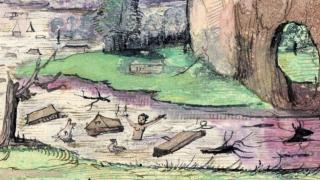
    A recent study published in »Communications Earth & Environment« suggests that volcanic activity in the mid-14th century set off a chain of events that ultimately contributed to the devastating spread of the Black Death across Europe. The study was carried out in collaboration between our colleague Martin Bauch from the GWZO and Ulf Büntgen’s group at the University of Cambridge. The researchers combined climate archives with historical documents to reconstruct the most comprehensive picture yet of the complex sequence of factors that led to millions of deaths and profound societal upheavals. The research illustrates how closely interconnected global networks, environmental conditions and health risks were, demonstrating the cascading effects that natural events can have on human societies.

    The study can be accessed here
    Ausschnit des Historische Weltkarte, Catalan Atlas von 1375, mit zahlreichen Flaggen, Figuren und dekorativen Elementen.
  • Gratulace! Professor Frank Hadler Awarded the »The František Palacký Honorary Medal for Merit in Historical Sciences«

    For his outstanding contributions to the field of historical sciences, Professor Frank Hadler, Head of the Department »Entanglements and Globalisation« at the Leibniz Institute for the History and Culture of Eastern Europe (GWZO), has been awarded the František Palacký Medal by the Academy of Sciences of the Czech Republic. The ceremonial presentation was held on 6 October 2025 in Prague, where the medal was conferred by the Academy’s President, Professor Radomír Pánek. This highest honour of the Academy recognises not only Professor Hadler’s research and publications on the history of historiography, the history of Czechoslovakia and the transnational history of East Central Europe, but also his long-standing and close cooperation with Czech historical scholarship. Since 2021, he has chaired the International Advisory Board of the Historical Institute of the Czech Academy of Sciences. From 2017 to 2024, he served as the German Co-Chair of the joint German-Czech and German-Slovak Historians’ Commissions.

    learn more
    Mann in kariertem Sakko hält geöffnete Urkunde mit Text zur tschechischen Ehrenmedaille für Verdienste in der Geschichtswissenschaft und Medaillendose.
  • New Release: Shlojme Bickel’s »Romania. History, Literary Criticism, Memories«

    In 37 chapters, this newly published annotated German translation from Yiddish offers a comprehensive overview of Jewish culture and Jewish life in Romania from the late nineteenth century to shortly after the Second World War. At the heart of the book are 47 biographical portraits of significant figures, along with numerous literary texts translated into German for the first time. The volume was published by Vandenhoeck & Ruprecht and edited by our GWZO colleague Gaëlle Fisher together with the Romanian literary scholar Francisca Solomon. The translation was completed by Martin Wiesche.

    To the book
    Buchcover mit Titel 'Rumänien. Geschichte, Literaturkritik, Erinnerungen' von Schlojme Bickel, darunter eine historische Gruppenaufnahme von Personen in Anzügen.
  • Workshop der AG Citizen Science

    Am 28. November 2025 nahm das GWZO am Workshop »Gesellschaft leisten« der AG Citizen Science des Leibniz-Labs Umbrüche und Transformationen am ZZF Potsdam teil. GWZO-Kollegin Sabine Stach präsentierte dabei das partizipative Schreibprojekt »Schreib dich durch die Neunziger«, das 2025 neue Perspektiven für Citizen-Science-Vorhaben eröffnete. Gemeinsam mit weiteren Leibniz-Instituten, darunter IRS und IDS, wurden im Workshop Chancen und Herausforderungen gesellschaftlich eingebundener Forschung diskutiert. 

    Die Themen des Workshops knüpfen an den Arbeitsschwerpunkt unserer Prager Abteilung »Wissen und Partizipation« an, die ihren Fokus auf den Beziehungen zwischen akademischer und außerakademischer Wissensproduktion richtet, sowie auf Möglichkeiten von Bürger*innenbeteiligung in Forschungsprojekten. 

    Ein ausführlicher Bericht erscheint demnächst bei H-Soz-Kult.

    Teilnehmer sitzen an einem langen Tisch in einem Konferenzraum mit Holzvertäfelung und abstrakten Gemälden an der Wand, Laptop und Getränke vor sich.
  • New Release: »The Early Slavs in State Socialism«

    In the second half of the 20th century, »Slavic archaeology«, the study of early historical and medieval Slavs based on material sources, became an important field of research in Central and Eastern Europe. In her study, Anne Kluger, a former researcher at the GWZO, shows how this field of research became politically and ideologically permeated. The focus is on the Polish People's Republic and the German Democratic Republic, whose Slavic studies had a conflict-ridden history. The study is the first comprehensive biographical analysis of archaeologists from the GDR and the Polish People's Republic and contributes to the history of Slavic reception and »images of Slavs«. It was awarded the Scientific Promotion Prize of the Polish Ambassador under the patronage of the Polish Academy of Sciences.

    To the book
    Buchcover mit zwei schwarz-weißen Porträts oben, Titel 'Die frühen Slawen im Staatssozialismus' von Anne Kluger auf rotem Hintergrund.
  • Online exhibition »Destroyed Ukrainian Heritage«

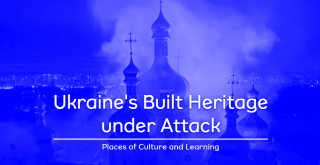
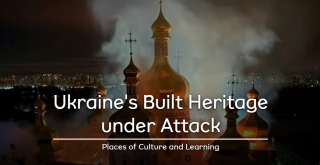
    Since the beginning of the Russian war of aggression against Ukraine, Ukraine's cultural heritage has also suffered immense losses. Kyiv architectural historian Dr. Semen Shyrochyn, in collaboration with the GWZO, has curated the English-language online exhibition »Destroyed Ukrainian Heritage. Ukraine's Built Heritage since February 24, 2022. A Record of Destruction«. It uses 40 selected examples from across Ukraine to show the extent and scope of the systematic destruction of Ukraine's built heritage. A podcast with further detailed information can be found here. Additionally, an analogue, roll-up version of the digital exhibition is touring Leipzig's district libraries. It is currently on display at the Schönefeld district library.

    To the online exhibition
    Zerstörtes mehrstöckiges Gebäude mit Trümmern und Schutt, umgeben von Bäumen und einigen Hochhäusern im Hintergrund
  • New Publication: »Original Ostblock: State Socialism in Tourist City Tours«

    History is increasingly being consumed as an experience. This is particularly true of historical tourism. What exactly happens when local history is sold to an international audience? Our GWZO colleague Sabine Stach explores this question using a central tourist format – the city tour. Taking the example of the increasingly popular »communism tours«, she examines how the legacy of the Cold War in Warsaw, Prague and Bratislava is interpreted for tourists and staged as an authentic experience. By combining perspectives from memory and heritage studies with approaches from tourism research, the work explores the complex relationship between local knowledge, transcultural memories, tourist needs and economic logic. The book was written as a habilitation project at the GWZO and the German Historical Institute Warsaw.

    to the book
    Buchcover von 'Original Ostblock' von Sabine Stach zeigt den Kulturpalast in Warschau, einen blauen Bus und Fahnen vor blauem Himmel.
  • Congratulations: Two GWZO Researchers Appointed to Visiting Professorships

    In the winter semester of 2025/2026, two colleagues from the GWZO were appointed to visiting professorships: Professor Orsolya Heinrich-Tamaska was appointed to an interim professorship at the Institute for Prehistory and Historical Archaeology at the University of Vienna, where she teaches courses on topics such as the »Archaeology of Equestrian (warrior) Nomadism«. Dr. Alexandr Osipian has been appointed to the Faculty of Social and Cultural Sciences at the European University Viadrina Frankfurt (Oder), where he holds the interim professorship »Entangled History of Ukraine«. We congratulate both of them and wish them much success!

    Zwei Personen, eine mit langen Haaren und Blazer, die andere mit kurzem Haar und kariertem Hemd, vor einfarbigem Hintergrund.
  • Now out: Volume 5 of the GWZO Handbook on the History of Art

    How does art react to war, destruction and upheaval? Volume 5 of the GWZO Handbook on the History of Art in Central and Eastern Europe, entitled »1570–1670: From the Renaissance to the Baroque«, is dedicated to art created during the transition from the Renaissance to the Baroque in the region. This period was characterised by numerous conflicts and migratory movements, leading to intensive artistic exchange. The volume explores a multifaceted artistic landscape resulting from these processes.

    This comprehensive work was edited by Agnieszka Gąsior, Director of the Silesian Museum in Görlitz and a former GWZO member of staff, and Marius Winzeler, Director of the Green Vault and the Armoury at the Dresden State Art Collections (SKD). Published by the Deutscher Kunstverlag, the book is available for purchase here: 

    To the book
    Schrift "New New New" übereinander, rechts daneben das Cover des fünften Bands des Kunsthandbuchs des GWZO, darauf ein Gemälde, welches verschiedene Personen darstellt und mit dem Titel überschrieben ist
  • Project on Occupied Territories in Ukraine Funded

    Since 2014, parts of eastern Ukraine have been under occupation. In these territories, Russia has pursued a rigorous policy of control, reorganisation and appropriation.

    Since September 2025, the project »Occupied and Erased: Stories of Ukraine’s Lost Homes« has been exploring these developments from the perspective of those affected, making their experiences accessible to a wider public. As a means of knowledge transfer, a digital »Museum of Lost Homes« is being created. Through personal stories, analytical insights and visual formats, it tells of dispossession, displacement and loss.

    Led by Sofia Gavrilova (IfL), the project is being carried out in cooperation with the Herder Institute and our GWZO colleague Daria Reznyk. It is funded within the framework of the Leibniz Lab Disruptions and Transformations.

    learn more
    Zerstörtes mehrstöckiges Wohnhaus in der Ukraine mit ausgebrannten und eingestürzten Bereichen neben einem ebenfalls beschädigten Gebäude unter bewölktem Himmel

Peace for Ukraine

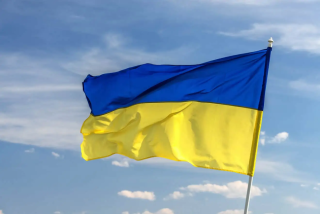
  • Ukraine Flagge
  • Our thoughts are with our Ukrainian friends and colleagues. On the orders of President Putin, on 24 February 2022, the Russian military launched an attack on a country at the heart of Europe – a nation with which we maintain diverse academic collaborations and where friends, colleagues and family members of our employees reside. As human beings, we are deeply concerned; as scholars, we are alarmed that massive historical distortions are being used as a pretext for an unlawful invasion. We appeal to the German public to listen to experts rather than historical fabrications when seeking to understand Central and Eastern Europe. We stand with the people of Ukraine in hoping for an end to the aggression, pay tribute to their courage and dedication and acknowledge the many individuals in Russia and Belarus who openly express criticism despite the risks they face.

    Information and Expertise

What's on at the GWZO

Conference

Abschlusskonferenz des Projektes DIKUSA

Location: Sächsische Akademie der Wissenschaften zu Leipzig

Book presentation

Burning Swamps: Peat and the Forgotten Margins of Russia’s Fossil Economy

Location: Strohsackpassage, 5. Stock, Raum 5.55, Leipzig

Prager Vorträge

Edition der Reden Adolf Hitlers von 1933 bis 1945. Werkstattbericht aus einem interdisziplinären Editionsprojekt

Dr. René Küpper (Munich)

Location: Prague/online

Show PDF