Virtuelle Ausstellungen



15.04.2026 -
15.04.2036
15.04.2036
onsite and online
»Was ist eigentlich Dissidenz?« – physical and digital
GWZO exhibition
GWZO
The exhibition offers insights into protest movements and forms of resistance from the 1960s to the 1980s, explores which experiences and attitudes still challenge and inspire us today and examines how they connect with our own history.
read more
19.02.2025 -
19.02.2035
19.02.2035
analog und online
Destroyed Ukrainian Heritage – analogue und digital
Curated by the GWZO
GWZO
The exhibition documents the systematic destruction of Ukraine’s architectural heritage since the start of Russia’s war of aggression, using selected examples from across the country. It highlights the scale of the losses whilst also drawing attention to the many examples of cultural identity that have so far been scarcely recorded or protected.
read more
29.08.2023 -
29.08.2030
29.08.2030
online
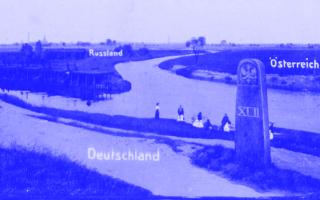
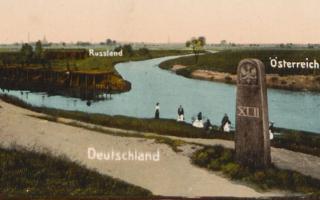
Dreikaisereck | The only such place on earth. Poles, Germans and Jews on postcards from the borderland - online
Academically supported by the GWZO
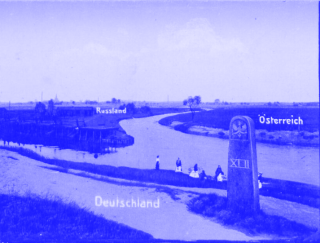
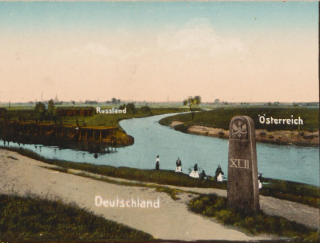
Ausschnitt: Volkstypen in der Dreikaisereck in alten Trachten, herausgegeben von Hermann Lukowski, Breslau, vor 1914 Schlesische Digitale Bibliothek
GWZO und das Zentrum für Historische Forschung Berlin der Polnischen Akademie der Wissenschaften
Entwickelt von Maciej Gugała als ein gemeinsames Projekt des Zentrums für Historische Forschung Berlin der Polnischen Akademie der Wissenschaften und des GWZO.
Die Ausstellung widmet sich Postkartendarstellungen von Menschen und ihrem Zusammenleben im historischen Dreikaisereck, an dem von 1846 bis 1915 die Grenzen Preußens, Österreichs und Russlands zusamenkamen.
01.10.2026 -
10.01.2027
10.01.2027
Old St. Nicholas School, Nikolaikichhof 2, 04109 Leipzig
From the German Empire to Reconstruction. The architect and town planner Hubert Ritter (1886–1967)
Curated by the GWZO
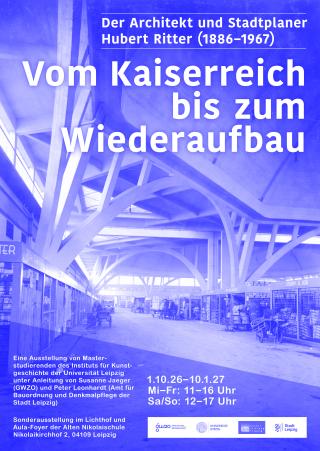
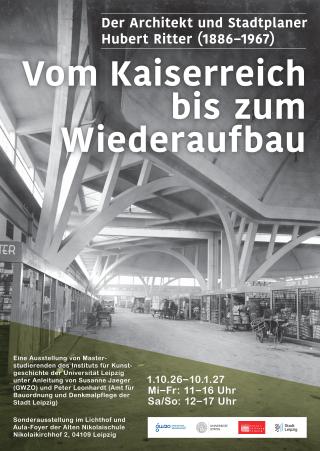
Leibniz Institute for the History and Culture of Eastern Europe (GWZO)
The exhibition showcases the work of the German architect Hubert Ritter, who was active from the late German Empire through to the era of the GDR and the Federal Republic of Germany. The focus is on Ritter’s work in Leipzig, where, as head of the Building Authority from 1924 to 1930, he pioneered modern architecture in the city through his urban planning designs, housing estates and public buildings. Among other projects, his designs gave rise to the »Rundling« housing estate and the »Großmarkthalle«, which brought Ritter national renown.
read more