Career support for Early Career Researchers: The GWZO supports scientific careers at all levels – from undergraduate studies to academic leadership positions. The institute’s junior research groups (JRG), funded either through third-party grants or its own budget, play a central role in this effort. As autonomous research units within the institute, JRGs provide promising graduates with the opportunity to pursue doctoral projects within a thematically cohesive group of scholars. At the same time, they allow postdoctoral researchers to develop innovative research projects, collaborate closely on typically third-party funded research with doctoral candidates, and gain valuable initial academic leadership experience.
GWZO Junior Research Group
Global Armenia/ns. Entangled Histories of Central and Eastern Europe and the Caucasus
Armenians have shaped the societies, cultures and politics of Central and Eastern Europe for centuries. In this Junior Research Group, we explore the multifaceted entanglements of Armenians, focusing on shared spaces of reference, encounter and action, as well as their transregional and international contexts.The focus of our inquiries ranges from the 19th century to the present day. We engage with methodological and theoretical debates in Armenian studies and comparative Central and Eastern European studies as well om entangled and global history, thereby situating Armenian-Eastern European interactions within a broader global context.
The group is headed by Dr. Katja Castryck-Naumann and Dr. mult. Bálint Kovács. In addition to supporting doctoral project, the JRG conducts several third-party funded initiatives.
It is a collaborative initiative funded by the Calouste Gulbenkian Foundation (Lisbon), the Higher Education and Science Committee, Ministry of Education, Science, Culture and Sport, the Republic of Armenia, the GWZO and other partners. Academic excellence is ensured by an advisory council of distinguished scholars.
Members of the Academic Advisory Council of the JRG:
- Edita Gzoyan, PhD (Armenian Genocide Museum-Institute, Yerevan)
- Dr. Petra Kostalova (Charles University, Prague)
- Dr. Karen Jallatyan (UC Irvine / GWZO Leipzig)
- Dr. Hakob Matevosyan (ZOiS Berlin / Leipzig University)
- Dr. Alexandr Osipian (GWZO Leipzig)
- Dr. Konrad Siekierski (King`s College, London / Freie Universität Berlin)
- Dr. Anatolii Tokmantcev (UC Los Angeles / PPCU Budapest)


Book Series »Armenier im östlichen Europa – Armenians in Eastern Europe«
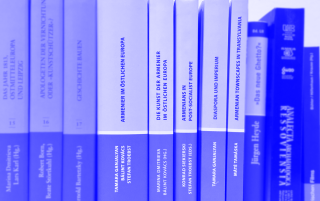
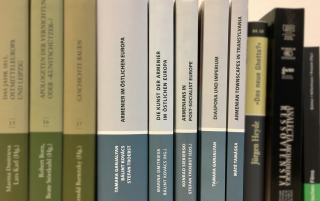
The bilingual German-English book series »Armenians in Eastern Europe« has been published since 2014. It presents current research on Armenians and makes scholarly literature and source materials – previously only available in less widely spoken languages – accessible to a larger audience through translation. Volumes 1 to 6 were published by Böhlau Verlag. Since volume 7, the series has been published in Open Access by the Dresden-based Sandstein Verlag.
Contact person for the book series is Bálint Kovács.
New Publication: Special Issue on the Armenian Diaspora
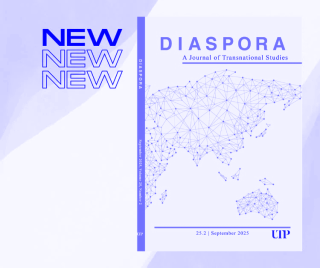
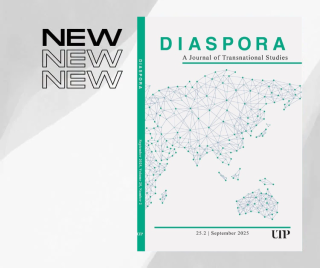
With the special issue »Layers of Diasporic Belonging: (Re)Evaluating Armenianness in Historical, Contemporary and Comparative Perspectives« (Diaspora, Vol. 25/2), former GWZO researcher Hakob Matevosyan and 2024 visiting scholar Vahe Sahakyan explore Armenian diasporic experiences in Eastern Europe and beyond. The volume builds on a GWZO workshop held in 2021.
GWZO in the Media: Armenia and the Diaspora
Armenian Memory Culture | Ani – Armenia’s Lost Capital
Documentary Series, 30 September 2026
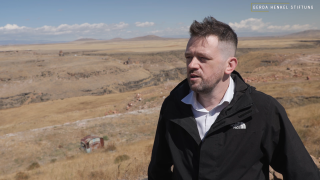
The historic ruined city of Ani is the focus of a new documentary series by the Gerda Henkel Foundation: »Ani – Armeniens verlorene Hauptstadt«. Once known as the »City of 1001 Churches« and a centre of prosperity in the Bagratid Kingdom, this UNESCO World Heritage Site now serves as a defining point of reference for the Armenian sense of identity. The research project is led by Bálint Kovács and Elke Shoghig Hartmann (FU Berlin); contributors include Ani expert and GWZO literary scholar Karen Jallatyan.
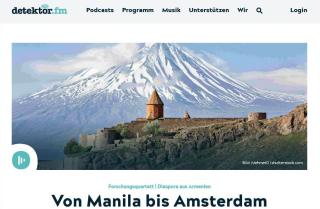
»Forschungsquartett« | Diaspora from Armenia
Podcast, detektor.fm from 15 December 2022
Armenians live not only in Armenia, but across the globe. Armenian communities have emerged on every continent at different points in history.
In this episode of the »Forschungsquartett« podcast, Dr. Hakob Matevosyan (formerly GWZO) talks to journalist Amelie Berboth about the experience of »being Armenian« abroad.
Cooperation talks in Yerevan: GWZO expands its work in Armenian Studies
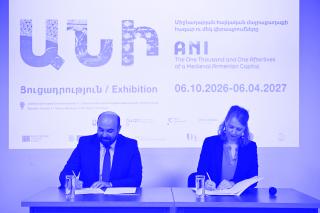
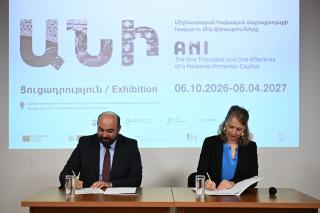
The Leibniz Institute for the History and Culture of Eastern Europe (GWZO) is further expanding its networking and research activities in the field of Armenian Studies: As part of a delegation visit by the City of Leipzig, GWZO Director Maren Röger and Bálint Kovács, leader of the GWZO junior research group »Global Armenia/ns«, held cooperation talks in Yerevan with prominent partner institutions – including Yerevan State University, the American University of Armenia and the renowned Matenadaran Institute of Manuscripts.
The visit took place against a special backdrop: during the trip, the City of Leipzig officially sealed its new town twinning partnership with the Armenian capital, Yerevan. From an academic perspective, a highlight was the signing of a new cooperation agreement between the GWZO and the National History Museum of Armenia, as well as the opening of a joint exhibition on the post-history of the historic capital Ani. The GWZO has been conducting intensive research into this topic for years – in particular the rich cultural history and the enduring legacy of this famous medieval metropolis, which went down in history as the »City of 1,001 Churches«.