MSCA Project Blog
MSCA Project Blog
This blog accompanies the MSCA research project »Women’s Politics and Postwar Reconstruction in Romania« by Alexandra Ghiț. How did women politicians and grassroots activists shape the postwar remaking of key political fields? RECKON will investigate the gendered transformation of public health, labour, foreign affairs and culture after World War II, with a focus on Romania 1944–1948.
It regularly features reflection pieces that provide insights into ongoing research, prefiguring interpretative lines and offering a glimpse of the findings to be unpacked in longer-format publications. The blog and the research project are funded by the European Union under the Marie Skłodowska-Curie Actions (MSCA).
If you’d like to comment, it will be easiest via the social media platforms – including LinkedIn and Bluesky – where new posts will be mentioned.
Edited by:
Alexandra Ghiț
alexandra.ghit@leibniz-gwzo.de
learn moreà
#2 Reconstruction | Revolution Historiographies – On Keeping our Postwar History Together
Already in 1944–1945, Western Europe had reconstruction, whereas Eastern Europe had social revolution – would be a brutal distillation of Tony Judt’s masterful analysis of developments on the continent. West of the Elbe, a band of »old men« – Adenauer (b. 1876), Churchill (b. 1874), Léon Blum (b. 1872), Alcide de Gasperi (b. 1881) – were trusted with the pragmatic restoration of as much as possible of all that had not been downright criminal of the world from before, essentially by turning to solving old social reform issues. These were matters first debated after the First World War (welfare laws, especially) but now tackled with relatively new (or newly-legitimate) tools, like »planism« – embraced in West Germany, France or the UK.[i]
East of the Elbe, from Czechoslovakia to Yugoslavia and Romania, significantly less grey and increasingly powerful communists could »promise to make a revolutionary beginning in countries where everyone had something to forget – things done to them or things they had done themselves«, argues Judd.[ii] It may be added that if old men symbolised Western reconstruction, women politicians from these »other« countries, some more radical than others, served as symbols of these early promises of radical change – Mitra Mitrović (b. 1912), Ana Pauker (b. 1893). Revolutionary rhetoric and iconography in the East, the pragmatic search for continuity in (what was becoming) the West would thus be the picture that emerges, even as the macroeconomic and social problems, as well as the highly interventionist solutions at hand, were quite similar.[iii] By 1948, the analogous and entangled approaches to dealing with the social issues produced by the war and its heavy aftermath had solidified into seemingly divergent social reform paths, running through opposing geopolitical camps.
Despite historians’ decades-long calls for understanding postwar Eastern and Western Europe as undergoing similar, and in fact interconnected, tectonic shifts in social and economic politics, historical analysis tools are still largely fashioned in the peculiar light of superpower politics. When, in 2011, I was writing a master’s thesis on women’s mass organisations in post-World War II Romania, I mainly reached for the historiography of the interwar Soviet Union and historical anthropology volumes on Romania (Verdery and Kligman’s award-winning Peasants Under Siege had just been published)[iv] to hone my interpretations. I spent little time considering comparable developments in Western Europe, and broadly interpreted local changes in terms of rapid social transformation rather than a potential quest for a return to an impossible »normality«. This seemed fully appropriate to what I was seeing in my sources.
My orientation as a young graduate student had to do, in part, with how research fields such as »women’s history« and »Eastern European history« were constructed. At the time, critical research in Soviet studies could model sophisticated approaches in gendered social history, in a way in which very little English-language research on state-socialist East-Central Europe could.
A lot has changed in the intervening fifteen years, not least in the abundance of research into women’s mass organisations after 1945, and communist women’s organising in East-Central Europe, in general. There is certainly more research synthesising regional trends. Yet we are far from being able to systematically conceive of and thoroughly document how mid- and long-term social trends in Europe cut across emerging Cold War divisions, shaping everyone’s lives but especially women’s trajectories.
As I looked more closely, in the past few months, at the historiography of post-World War II reconstruction across Europe, the evidence mounted against the »early East-West divergence« thesis. The contestability of social revolution as panacea in the postwar East (but not the West) became clearer. This was not – or rather not primarily – a history of »old statesmen« in Western Europe and radical, Resistance-hardened, communist women in Eastern Europe, brought to power by Soviet fiat.
Reading Molly Tambor’s 2014 monograph, The Lost Wave: Women and Democracy in Postwar Italy, I was struck by the many similarities to the Romanian context in the immediate postwar years.[v] Tambor’s book focuses on a remarkable first large group of women, Communists and Catholics, elected to the first postwar legislatures in Italy and the women’s associational culture – on the left and the centre-right (or religious-left) – which sustained these »women activists« struggle for enshrining women’s rights in Italy’s post-fascist constitutional order. In my research for RECKON, I have been looking very closely at women MPs in the first, 1946–1947, Romanian legislature.
In both Italy and Romania, women could elect representatives to parliament only beginning with 1946. In both countries, the first elections brought an unprecedented number of women politicians to national level politics: 22 out of 586 members in the first Constituent Assembly of 1946–1947 in Italy, and 14 out of 414 in the Kingdom of Romania’s Assembly of Deputies – the latter in office until April 1948, when Romania became a popular republic; Italy had voted to abolish its monarchy already in 1946.
In Italy, the women MPs in this and subsequent legislatures cooperated across otherwise stark party lines, into the early 1960s, for civil laws which guaranteed women’s formal equality as well as welfare laws protecting women and children. In Romania, most of the women MPs in the first postwar legislature came from the ranks of the once rival Social-Democratic and Communist Parties, now tenuously united in a Bloc of Democratic Parties. Their impact into the 1960s is unclear but likely similar to that in Italy.
In both countries, the women MPs had deep roots and organisational links in women’s mass organisations. In Italy, the communist Union of Italian Women (UDI) and the Italian Women’s Centre (CIF); in Romania, the Union of Antifascist Women of Romania (UFAR), as well as a range of other associations in which women were especially active, such as the Patriotic Defence (AP). In both contexts, most of the women elected had – in one way or another – participated in wartime resistance activities.
In both Italy and Romania, this first group of women MPs was largely forgotten and misunderstood. Tambor argues that beyond their divisions, early postwar Italian »women activist« MPs saw comprehensive women’s rights as indispensable to the making of a democratic Italy, with long-term consequences. In Romania, and across East-Central Europe, the role of these women activists with parliamentary histories has yet to be traced as a part of a clearly Europe-wide history of reconstruction through comprehensive social transformations marked by compromises and occasionally odd alliances. There are now ways to fashion better research instruments for this task, luckily.
The Cold War may have divided disciplines, rerouted questions and imposed a binary interpretation framework onto most phenomena. But this does not mean distinct, Eastern and Western, socialist and non-socialist historical realities emerged rapidly. The clues that they did not are everywhere, given enough time for reading.
»We’ve got to keep it together.« This entreaty regards the historiographies of the twentieth century, as well as the lives of researchers: I tell myself this as I pack up my office ahead of a longer, and I suspect happily overwhelming, absence – for parental leave. The next blog post will be in around seven months, when I am back.
[i] Tony Judt, Postwar: A History of Europe Since 1945 (Penguin, 2005; repr., Pimlico, 2007), 64–82.
[ii] Judt, Postwar, 61.
[iii] Mark Mazower, »Changing Trends in the Historiography of Postwar Europe, East and West«, International Labor and Working-Class History 58 (2000): 281.
[iv] Gail Kligman and Katherine Verdery, Peasants Under Siege: The Collectivization of Romanian Agriculture, 1949-1962 (Princeton University Press, 2011).
[v] Molly Tambor, The Lost Wave: Women and Democracy in Postwar Italy (Oxford University Press, 2014).
#1 Starting from the Rough Edges: On Researching Mid – 1940s Brochures and the History of Postwar Romania
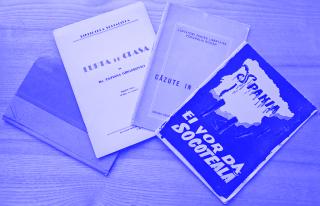
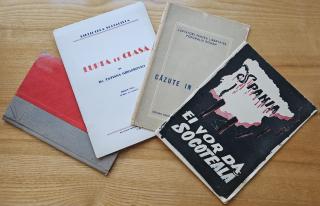
In post-World War II Romania gendered cultural transformation felt like rough, grainy paper. Notebook-sized brochures destined for women’s non-formal education were the cheap, effective, transitional format for an incipient, eventually decades-long, process of change.
For the »transitional period« 1944–1948 such brochures – testifying to postwar penury and indexing an older history of socialist organizing – are essential sources. They reflect an ideologically diverse, locally rooted, transnationally connected, practice of education and agitation. Despite their flimsiness and relative obscurity, they are indispensable for understanding women politicians’ and grassroots activists’ influence on postwar reconstruction.
Between August 1944, when the hitherto Axis-member Kingdom of Romania concluded an armistice with the Allies, and December 1948, when the Kingdom became a People’s Republic, women’s political rights evolved. All women over 21 years of age, regardless of education or professional background, could vote as of July 1946; many cast their first votes in that November’s elections.
Women’s citizenship became strongly associated with activism.[i] Thousands of young women were mobilized as volunteers for anti-famine and anti-malaria relief work in eastern Romania. Just as many became part of the Union of Antifascist Women of Romania (UFAR), a »women’s mass organization« helping gain women’s support for the left-wing Bloc of Democratic Parties (BPD) but, with equal commitment, organizing social assistance and small-scale relief work in various towns. Many of the grassroots activists mobilized in this way conducted ad-hoc literacy campaigns and reading circles, where important articles might be read out loud.
Brochures were a crucial tool in non-formal adult education for literacy, as well as in what might be called in retrospect »education for citizenship«. Their style and format had precedents in other places in Europe, but just as much in the socialist and social-democratic worker education initiatives and print cultures of pre-1944 Romania. For instance, in 1945, the publishing house of the Social Democratic Party would print in its »Socialist Library« series the seventh, revised, edition of a brochure titled The Class Struggle.[ii] Authored by anticommunist social-democrat Tatiana Grigorovici,[iii] the 26-page booklet provided an accessible introduction to the concept. It had first appeared in 1909, and was steadily reprinted, with various revisions, since.
Original, short, quasi-ephemeral, publications were born of necessity as much as of the quest for political efficacy. A crisis of printing paper in 1944–1947 likely made the printing of brochures, rather than of textbooks or books, more feasible and affordable for various women’s organizations. With rare exceptions, brochures aimed at women readers were printed on dark, rough, acidic paper, without illustrations or significant graphic features – but were generally carefully typeset. They were written in clear and simple language, in short sentences, with plots and settings meant to seem immediately familiar to readers and listeners. For example, a 1946 booklet on women’s vote begins with a conversation between two women from the same village, about dealing with women’s issues in their community; the discussion about suffrage is intertwined with details about traditional, communal wool spinning.[iv]
Brevity, minimal aesthetic qualities and negative association with propaganda obscures brochures’ distinctiveness as a corpus of sources. Yet for a period when political instability is far easier to spot than any policy trends, the titles and content of such small format publications reveal clear priorities and policies for gendered reconstruction.
The 1944 brochure Words for Women, authored by social-democrat Eugenia Deleanu Rădăceanu, reissued at least three times by 1945, proves that social-democratic demands from before the war were restated and integrated into what would become key promises in the BPD’s 1946 Platform-Program and policies in the future People’s Republic.[v] The 1945 The First Congress of the Union of French Women (including details on the international preparatory congress for the founding of the Women’s International Democratic Federation),[vi] and the Woman and Child in the Soviet Union (comprising two texts, by UFAR president Alexandra Sidorovici and Minister of Health Florica Bagdasar) reflect the rapid multilateral re-internationalization of women’s politics after the war, besides the growing influence of Soviet policy models.[vii] The 1946 brochures From Disregard to Equality by »fellow-traveller« Theodosia Graur,[viii]We Too Are Voting by communist writer Elisabeta Luca,[ix] or Gabriela Deleanu’s Woman and the Right to Vote testify to the significant rhetorical production around women’s suffrage and underscore the political stakes of this expansion of citizenship.[x]
After 1948, commemorative brochures, such as [Women Comrades] Fallen in the Struggle and Spain – They Will Have to Account for their Deeds focus on women heroes of the communist movement, in Romania and abroad.[xi] Such narratives mark the end of the short, postwar period of explicit cooperation between communist women and women affiliated with women’s organizations with different »democratic« or »progressive« ideological stances.
Like the brochures that shaped it, the period 1944–1948 has its own rough edges –historically and historiographically. It is often described as a short transitional period which ushered in the bipolar world of the Cold War. However, like the brochures, it was more important than it may seem, bridging systems and shaping continuities. In my research project, focused on these early postwar years, I will investigate processes that recovered or discarded elements of older gendered social contracts in the making of a new one.
[i] For a discussion of the significance of aktivnost in the Stalin Constitution of 1936, see Golfo Alexopoulos, »Soviet Citizenship, More or Less: Rights, Emotions, and States of Civic Belonging«, Kritika: Explorations in Russian and Eurasian History 7, no. 3 (2006): 487–528.
[ii] Tatiana Grigorovici, Lupta de Clasă [Class Struggle], 7th ed., Biblioteca Socialistă (Editura Partidului Social-Democrat, 1945).
[iii] Alexandra Ghiț, »Tatiana Grigorovici: Ambiguities of a Social Democrat’s Career«, ZARAH Blog, February 10, 2021, https://zarah-ceu.org/tatiana-grigorovici-ambiguities-of-a-social-democrats-career/.
[iv] Elisabeta Luca, Votăm Și Noi [We Too Are Voting], 2nd ed. (Federația Democratică a Femeilor din România, 1946).
[v] Eugenia Rădăceanu, Cuvinte pentru femei [Words for women], 3rd ed. (Ed. Uniunea Femeilor Muncitoare, 1945).
[vi] Primul congres național al Uniunii Femeilor Franceze [The First National Congress of the Union of French Women] (UFAR, 1945).
[vii] Comisia Femenină a Consiliului Sindicatelor, Femeia și copilul în Uniunea Sovietică [Woman and child in the Soviet Union] (Ateneul Józsa Béla, 1945).
[viii] Theodosia Graur, Dela dispreț la egalitate: Articole, cuvântări și conferințe 1945–1946 [From disregard to equality: Articles, speeches and conferences 1945–1946] (Editura Federației Democrate a Femeilor din România, 1946).
[ix] Luca, Votăm Și Noi [We Too Are Voting].
[x] Gabriela Deleanu, Femeia și dreptul de vot [Woman and the right to vote], Probleme Românești (1946).
[xi] Căzute în luptă [Fallen in the struggle], Luptători Pentru Libertatea Poporului Roman (Editura Partidului Muncitoresc Român, 1949); Spania – Ei vor da socoteală [Spain – They Will Have to Account for their Deeds] (Editura UFDR, [1948?]).